Failure Mode Guide: What's Worth Fixing and What Isn't
You’ve picked up a non-working Mathmos lamp for next to nothing, and now you’re staring at it wondering whether you’ve made a brilliant find or a very decorative mistake. The honest answer: it depends entirely on which kind of broken it is. Some failure modes are satisfying afternoon projects. Others are dead ends no amount of effort will fix. Here’s how to tell the difference before you commit.
The Easy Wins: Cloudy Fluid and Sluggish Wax
Cloudy fluid is probably the most common complaint, and it’s also one of the most recoverable. Over time, the liquid inside a Mathmos lamp can turn hazy, grey, or develop a milky film — usually the result of age, UV degradation, or being stored in the wrong conditions. It looks awful, but in many cases the underlying chemistry hasn’t fully broken down. Our guide to restoring cloudy lava lamp fluid walks through what’s actually happening at a molecular level and which cloudiness types respond to intervention.
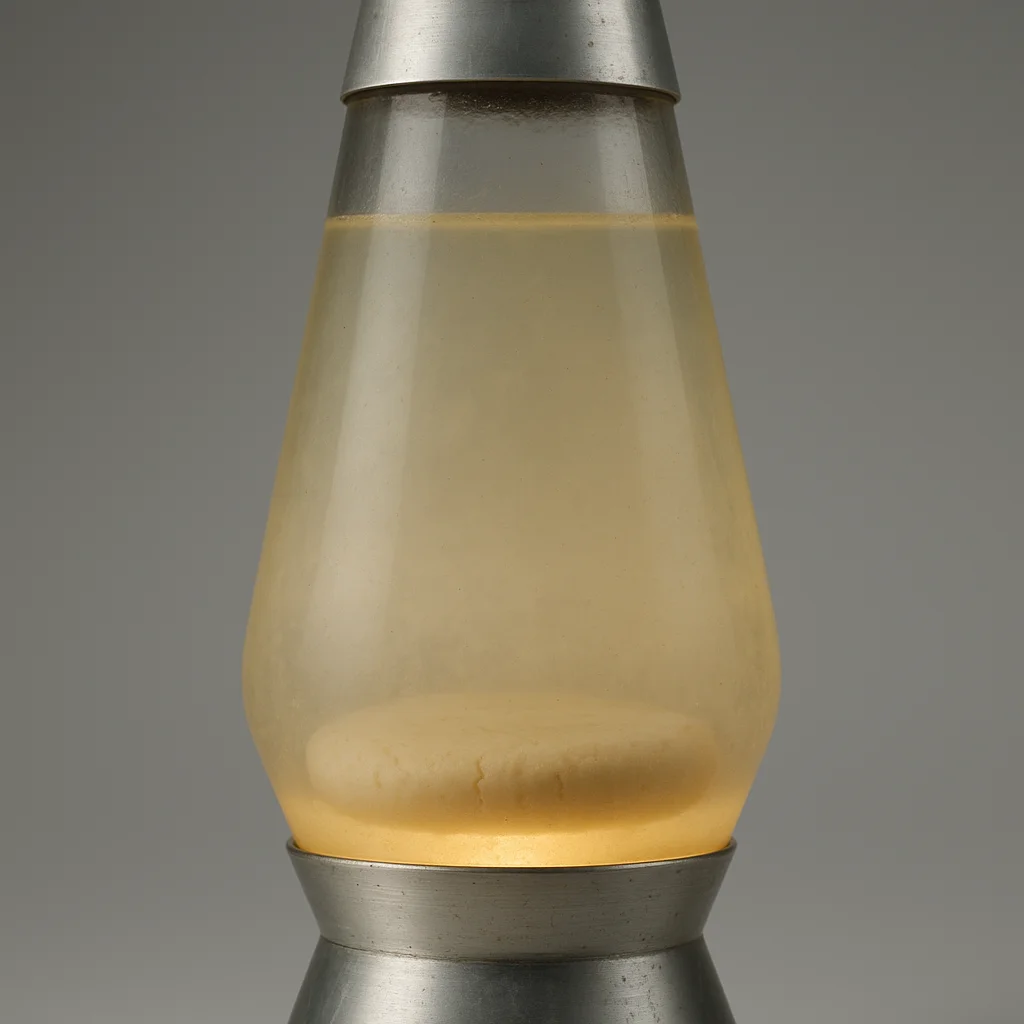
Sluggish or poorly flowing wax is another restorable condition. If the wax sits in a flat disc at the bottom and barely rises even after a long warm-up, the lamp may simply have been unused for years. Extended rest can cause the wax compound to harden or partially separate. Give it time — sometimes several hours of gentle heat over multiple sessions — before writing it off.
The Harder Cases: Separation, Discolouration, and Phase Failure
Things get more complicated when the wax and fluid have genuinely separated in a chemical sense — not just sitting apart, but refusing to interact correctly even at the right temperature. You might see wax that floats permanently, or fluid that has turned an opaque brownish-grey with a greasy film on the surface. This is phase failure: the density balance that makes a lava lamp work has shifted beyond casual correction.
Is it salvageable? Sometimes, yes — but it depends on how far things have gone. Mild phase shift can occasionally be addressed through the kind of component substitution approaches this site covers. Severe separation, however, where the compounds have visibly degraded into distinct layers that won’t recombine, generally means the fluid needs replacing rather than restoring. That’s a bigger project, but not an impossible one.
Discolouration of the wax itself — going from the original vibrant colour to a dull, faded, or stained appearance — is worth noting but rarely a dealbreaker for function. It affects aesthetics, not flow behaviour.
The Genuine Dead Ends
Some failure modes simply aren’t recoverable, and it’s worth knowing this before you invest hours. A cracked or crazed globe — fine stress fractures in the glass — is a safety issue, not a restoration project. The glass on vintage Mathmos lamps is not easily replaced with a functionally equivalent substitute, and a compromised vessel can fail under thermal stress. Walk away from these.
Corroded or burned-out electrical bases are a more nuanced case. Mild corrosion on the exterior is cosmetic. But if the wiring inside has been heat-damaged, the lamp has been run with incorrect bulbs over a long period, or the socket shows signs of arcing, the base is compromised in ways that introduce real risk. Our diagnosis guide covers how to assess a base properly before making any decisions.
Finally: lamps that have been filled with substitute fluids by a previous owner can be genuinely unpredictable. The original compound balance is gone, and what’s inside may not behave predictably under heat.
Knowing which category your lamp falls into is the real first step — it turns an intimidating project into a sensible plan. If you’re still not sure what you’re dealing with, the failure mode diagnosis guide is the logical next stop, and the FAQ covers many of the specific questions that come up along the way.