Substituting Degraded Components with Modern Materials
Why Substitution Is Sometimes the Only Option
Original Mathmos components — the wax compound, the proprietary fluid, the globe caps, the fittings — were engineered as a system. They were designed to work together, and for many lamps still in circulation, several decades have passed since those components were fresh. Wax degrades. Fluid clouds and separates. Caps corrode or crack. And because Mathmos produces a relatively small range of specialist products, replacement parts for discontinued models simply aren’t always available.
That’s where thoughtful substitution comes in. Done carefully, it can absolutely bring a lamp back to life. Done carelessly, it produces a lamp that either doesn’t work or — in the case of fluid chemistry gone wrong — becomes a safety concern. This guide walks through the main component categories and what modern materials can realistically stand in for them.
Substituting the Wax Compound
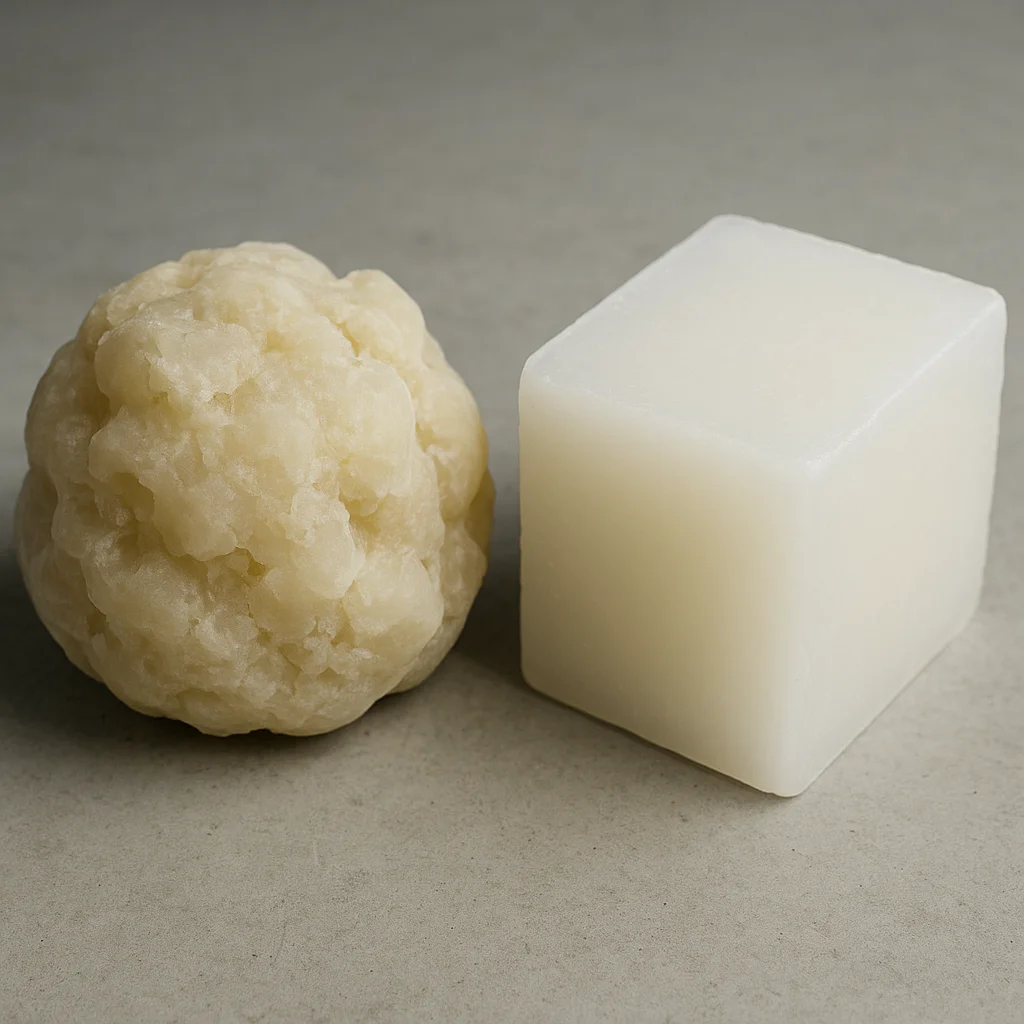
The wax blob in a Mathmos lamp is a precise blend — typically paraffin wax with additives that tune its density so it sits just at the boundary between floating and sinking at operating temperature. This density relationship is everything. Too light and the wax pools permanently at the top; too heavy and it sits on the bottom like a dead weight.
When the original wax has degraded — broken into granules, gone permanently cloudy, or lost its elasticity — a straight paraffin wax substitution is a reasonable starting point. Paraffin wax with a melting point in the 58–62 °C range is the most commonly cited match for standard Mathmos globe sizes. The challenge is fine-tuning. A small addition of a denser material — microcrystalline wax is one option, as it blends smoothly and raises density without dramatically altering melt behaviour — lets you adjust until the wax floats sluggishly at temperature rather than either rushing upward or refusing to lift.
This is iterative work. Expect to test, adjust, and test again. The diagnosis guide can help you confirm whether the density balance is actually the problem before you begin.
Substituting the Fluid
The fluid in most Mathmos lamps is a water-based solution containing a surfactant and sometimes a small amount of a water-soluble polymer to adjust viscosity. It’s the medium through which the wax moves, and it also plays a critical role in governing heat transfer from the base upward.
Distilled water is the essential starting point for any fluid substitution — tap water introduces minerals that cause cloudiness over time, which is often what you’re trying to fix in the first place. A small quantity of a standard surfactant (washing-up liquid in very small concentrations has been used experimentally, though dedicated surfactants give more predictable results) can replicate the surface tension properties of the original fluid. Propylene glycol in low concentrations is sometimes used to add a slight viscosity adjustment that slows the wax’s movement into something more satisfying and hypnotic.
The fluid restoration guide covers this in more detail, including how to assess whether your existing fluid can be cleaned rather than replaced entirely — which is always preferable from both a practical and environmental standpoint.
Caps, Fittings, and Globes
Physical component failures are often overlooked but genuinely common. Threaded caps corrode, rubber seals perish, and the occasional globe arrives with a hairline crack. These are worth inspecting carefully before any fluid work begins — there’s little point perfecting your fluid chemistry if the cap leaks.
For corroded metal caps, the options are limited: careful cleaning with a mild acid solution can sometimes restore a functional thread, but a cap that’s structurally compromised needs replacement. Sourcing equivalent-sized aluminium or brass caps from specialist hardware suppliers is possible for many globe diameters. Replacement seals cut from nitrile rubber sheet are a good general substitute for perished originals, being both chemically resistant and long-lasting.
For anything more complex — bulb holder failures, base wiring, or globe shape — the failure modes guide is the honest place to start, because some component failures genuinely aren’t worth pursuing.
Substitution is a craft, not a shortcut. When it works, you’ve rescued something that would otherwise end up in landfill. For context on which lamps are most amenable to this kind of restoration work, the Mathmos models reference is a useful companion to everything on this page.