Restoring Cloudy Lava Lamp Fluid
Why Lava Lamp Fluid Goes Cloudy
The fluid inside a Mathmos lamp isn’t just coloured water — it’s a carefully balanced mixture, and over time that balance breaks down. The most common culprit is heat cycling. Every time the lamp is switched on and off, the fluid expands and contracts, and the surfactants that keep everything suspended gradually lose their effectiveness. The result is a murky, greyed-out liquid that looks nothing like the jewel-bright original.
UV exposure makes things worse. A lamp left near a sunny window can degrade both the fluid’s dye and its chemical structure faster than years of normal use. And if someone has ever topped up the fluid with tap water — it happens — mineral contamination and chlorine can trigger a reaction that makes the whole thing look like diluted milk.
So the wax has separated into a greasy film and the fluid is grey and opaque — is it salvageable? Often, yes. But the answer depends on why it’s cloudy, and that distinction genuinely matters before you do anything else.
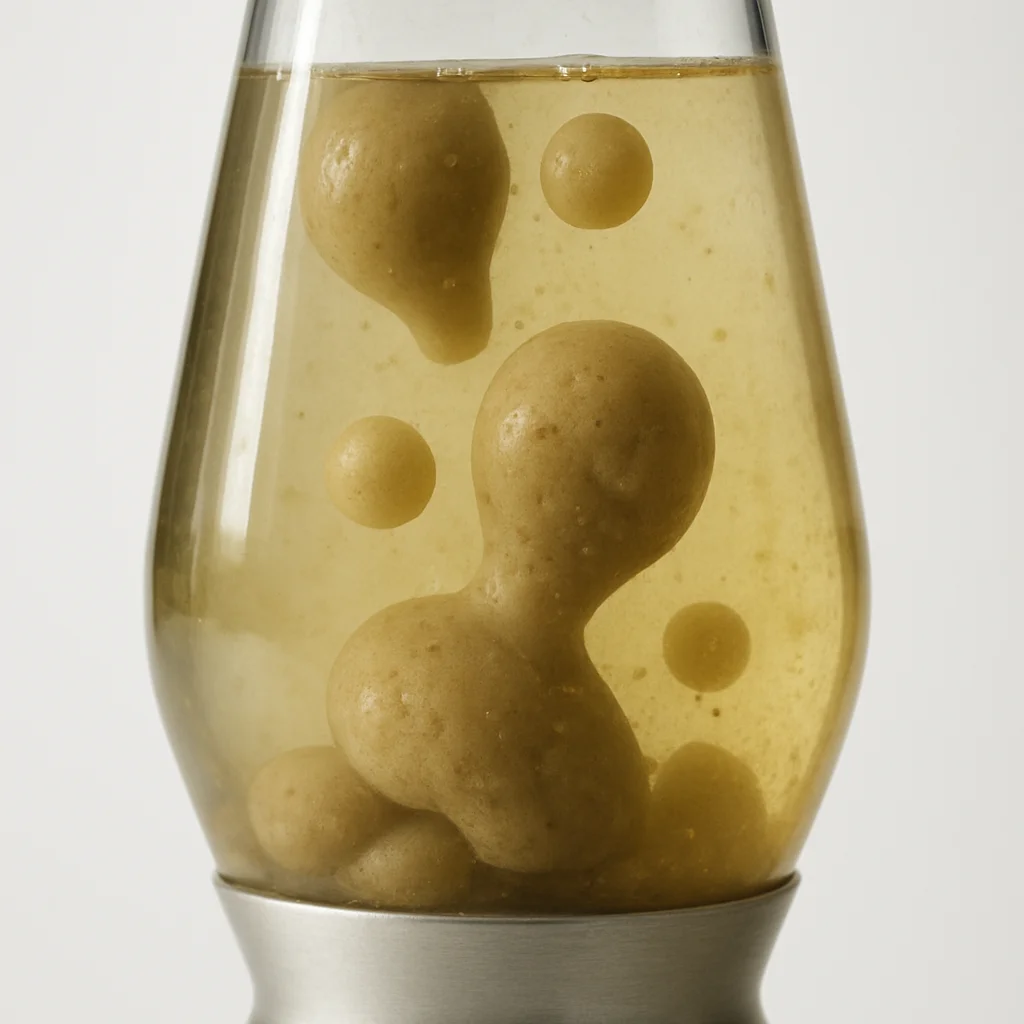
Diagnosing the Type of Cloudiness
Not all cloudiness is the same, and a quick visual test when the lamp is cold can tell you a lot. Shake the lamp very gently and watch what happens. If the fluid clears slightly before settling back to murky, you’re likely dealing with surfactant breakdown or dye dispersion — both of which respond well to restoration approaches. If it stays uniformly opaque and dense, with a slightly greasy sheen, there may be wax emulsification involved, which is a harder problem.
Also check the wax itself when cold. Healthy wax sits at the bottom as a single cohesive disc or pool. Wax that has split into dozens of tiny floating beads, or that has gone permanently sticky and stringy, is a sign that the thermal balance of the fluid has shifted — likely because the fluid density has changed. Restoring the fluid won’t fix the wax behaviour in that case; you’re looking at a more involved intervention, and our failure mode guide covers when that crosses from fixable into not-worth-the-effort territory.
Approaches to Fluid Restoration
For straightforward surfactant-related cloudiness, the most effective approach is a full fluid replacement rather than attempting to revive what’s there. The original fluid chemistry is proprietary, but the underlying principle — distilled water, a water-soluble dye, and a small quantity of surfactant — can be replicated using accessible materials. Our component substitution guide goes into this in practical detail.
If you want to try clearing the existing fluid first, here’s the key rule: use only distilled or deionised water if you’re adding anything. Tap water will compound the problem. Some cloudiness caused by dye dispersion can be temporarily improved by allowing the lamp to sit undisturbed and cold for 48 hours, then running it at the correct temperature for a full cycle. This occasionally re-homogenises the mixture. Don’t expect miracles, but it costs nothing to try before committing to a full drain.
Whatever you do, avoid the temptation to add random household chemicals to “fix” the colour. Dish soap, for instance, will change the surface tension enough to ruin the wax behaviour permanently, even if the fluid temporarily looks clearer.
When the Fluid Cannot Be Saved
Some fluid is simply beyond recovery — particularly in lamps that have been stored for decades in poor conditions or exposed to extreme temperatures. If the fluid smells strongly chemical or has developed a solid residue at the base, it needs to come out. Disposing of lava lamp fluid isn’t quite as simple as pouring it down the sink, and our responsible disposal guide explains the correct approach.
Cloudy fluid is one of the most common reasons a Mathmos lamp gets written off prematurely — and one of the most frequently fixable. Start with the diagnosis guide if you’re still unsure what you’re dealing with, and work from there.